Short answer: all three are agents with their own cloud computer that keep working when you close the laptop, but they're built for different people. Grok Bot is a team of specialised Bots you trigger with schedules and events, and you can share them. OpenAI's dots give you one agent that learns how you work across ChatGPT, Slack and Teams. Claude Duet is the most cautious of the three: a personal agent that checks your accounts every few hours, briefs you each morning and asks before anything consequential.
How we compared them
In the space of ten weeks, xAI, OpenAI and Anthropic each shipped an agent that works while you're away. xAI went first with Grok Bot on August 11. OpenAI followed with dots on September 29, and Anthropic opened a research preview of Claude Duet on October 21. Shortly after Duet's announcement, one reply from an OpenAI engineer summed up the mood: "Dot, meet Duet." The race is clearly on.
Everything below comes from each company's own announcement, help center and documentation, read on October 31, 2026. Where we rely on anyone else, we say so. One honest caveat: Claude Duet is a US-only waitlist and dots are limited to certain paid plans, so this is a comparison of what each product does and promises, not a benchmark of how well each one performs. All three are moving fast, so check the linked sources before you rely on a specific limit.
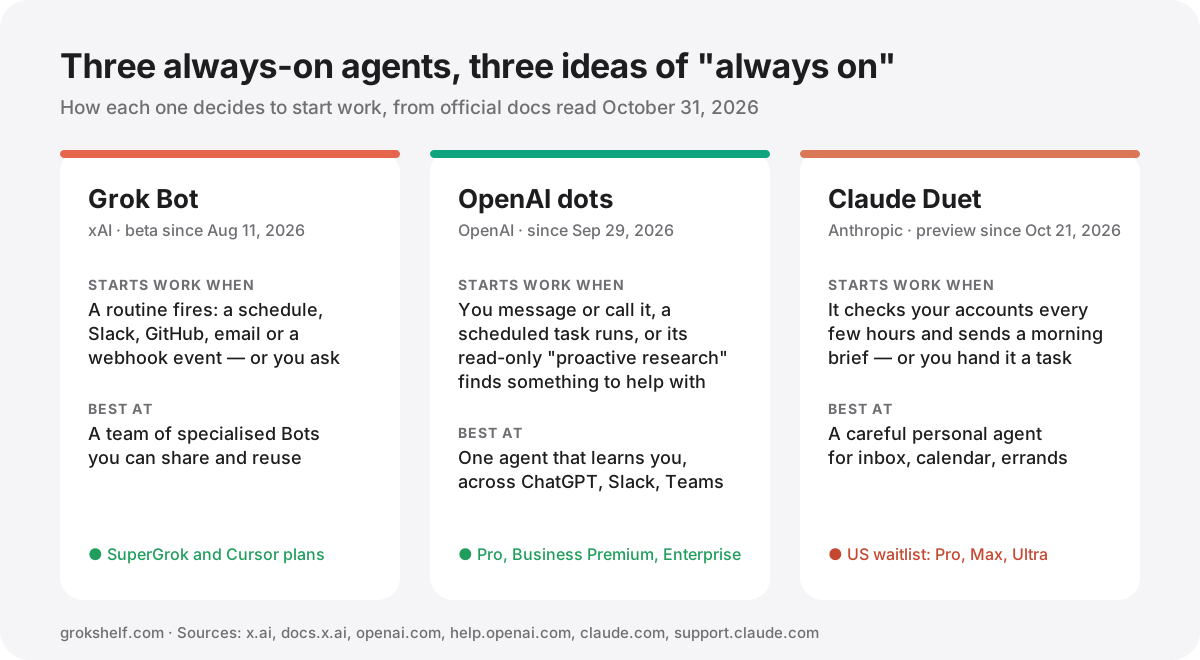
Side-by-side comparison
| Grok Bot (xAI) | dots (OpenAI) | Claude Duet (Anthropic) | |
|---|---|---|---|
| Launched | August 11, 2026, beta | September 29, 2026 | October 21, 2026, research preview |
| Model | Not named on xAI's launch page | GPT-6 Astra | Claude Opus 5.5, not selectable |
| Its own computer | Yes, a cloud computer your Bots share | Yes, a cloud computer and browser per dot; you can open it any time | Yes, a virtual machine with its own browser; you can't watch it yet |
| How many agents | As many Bots as you build | One primary dot today; more dots promised | One Duet |
| What starts work | Chat, schedules and events from Slack, GitHub, Linear, Sentry, PagerDuty, email or webhooks | Chat, voice calls, scheduled tasks and read-only proactive research | Checks connected accounts every few hours, a morning brief, and tasks you assign |
| Where you talk to it | Desktop and iOS apps, Slack | ChatGPT desktop, web and mobile, Slack, Teams; texting in US beta | Its own iOS and Android app, and claude.ai on the web |
| Connectors | Connected apps, logins and a browser | Over 4,000 apps through plugins | Over 6,000 connectors and plugins; no Microsoft 365 yet |
| Approvals | You set them; xAI recommends approval for sending, buying, deleting, publishing and production changes | Built-in rules plus your Custom Rules; auto-review checks risky actions | Always asks before sending, paying, signing or deleting |
| Hard limits | Up to 50 routines per Bot | Some tasks, like changing a password, always stay with you | Never trades securities or moves money between accounts, even with approval |
| Sharing and teams | Share with your team or publish a public x.ai/bot template | Specialist dots for organisations, in enterprise pilots | Personal only; Team and Enterprise not supported yet |
| Who can get it | SuperGrok plans and Cursor Pro, Pro+, Ultra and Teams | Pro and Business Premium in eligible markets; Enterprise beta | US Pro, Max and Ultra subscribers, by waitlist |
| Extra cost | Usage metered separately from Grok and Cursor allowances | First dot included; chats with it don't count toward ChatGPT limits | Included during the preview; uses your normal Claude limits |
Grok Bot: a team of agents you design
xAI pitched Grok Bot as "your team of always-on agents", and the team part is the real difference. Instead of one assistant, you create several Bots, each with its own job, chat and routines, working on a cloud computer of their own. They sign in to the tools you already use, including sites with no clean API, and come back to you when something needs approval (xAI announcement).
Grok Bot is also the most explicit of the three about when work happens. A routine runs on a schedule, such as every weekday at 8 a.m., or when an event arrives from Slack, GitHub, Linear, Sentry, PagerDuty, email or a webhook. Each Bot can own up to 50 routines, and reusable skills are shared across all your Bots. You can even teach a skill by demonstrating a browser task for up to ten minutes (xAI docs).
It's also the only one built for sharing. Teams can share the same Bot with chat-only or manager roles (shared Bots docs), and creators publish public x.ai/bot templates that anyone can copy. That's why a directory like GrokShelf's verified shared Bots exists at all. If you want to see what people build with it, start with the best Grok Bots for coding, research and productivity.
OpenAI dots: one agent that learns you
OpenAI calls dots "remarkably capable, always-on agents built to handle everything". Each one runs on GPT-6 Astra with its own cloud computer and browser, connects to more than 4,000 apps through plugins and, OpenAI says, learns your preferences and "what good looks like to you" the more you work together (OpenAI).
Dots meet you where you already are: ChatGPT on desktop, web and mobile, plus Slack and Teams, with voice calls and a US texting beta for some Pro users. When you're not talking to it, a dot does "proactive research" using your connected apps through read-only tools, so it can't send messages or change anything on its own while it looks for ways to help. You can open its computer to inspect its work, and optionally let it use your own laptop, which is off by default (OpenAI Help Center).
Control comes from built-in rules and your own Custom Rules, which can allow, require approval for or block specific actions, plus an auto-review step that checks risky actions against them. A monitoring system can pause or stop a dot if it detects a safety concern. Today you get one primary dot; OpenAI says you'll be able to add more later, and specialist dots for companies are in enterprise pilots, including with Microsoft's Agent 365.
Claude Duet: the careful personal agent
Anthropic's pitch is restraint. Claude Duet is "a new app where Claude works as a proactive agent" that comes to you with what needs attention, completes the tasks you give it, keeps working when you step away and "checks with you before it acts on your behalf" (Claude on X). Each morning it sends a short brief on the most important items across your connected apps (Anthropic).
It runs on Claude Opus 5.5 in its own virtual machine and browser, and you can't choose another model; Duet decides how much effort each job needs. It carries over your memory, skills and connected apps from your Claude account, so there's little setup (Claude on X). It reaches Gmail, Google Calendar, Google Drive, Slack, QuickBooks, HubSpot, Docusign and Calendly, among 6,000-plus connectors, and uses a one-time card for each purchase (Claude Help Center).
The guardrails are the strictest here. Duet shows you exactly what it's about to do before it sends, pays, signs or deletes, and some actions, like trading securities or moving money between accounts, are off-limits even with your approval. It never sees your passwords, and a separate classifier stops it from sharing the most sensitive data, such as card numbers and government IDs. Anthropic is upfront about the gaps: Duet checks your accounts only every few hours, can misjudge urgency, can't show you its browser and lives in an app separate from the main Claude app.
The differences that actually matter
Who decides when work starts. Grok Bot does what you've scheduled or wired to events, which makes it predictable. Dots look for ways to help on their own, but only with read-only tools until you engage. Duet checks in on a fixed rhythm and briefs you. If surprises make you nervous, Grok Bot and Duet are the calmer choices.
One agent or many. Grok Bot is built for several specialised Bots that you can share with a team. Dots and Duet each give you a single personal agent today, and OpenAI is the only one promising more per person.
Where you live. If your day runs on ChatGPT, Slack or Teams, dots fit most naturally. If you're already a Claude user, Duet inherits everything you've set up. If your team works in Cursor or on GitHub and Linear, Grok Bot's event triggers are hard to beat.
How careful it is with money. All three ask before consequential actions, but only Duet puts some financial actions permanently off-limits and issues a one-time card for every purchase.
Which one should you choose?
- Choose Grok Bot if you want a team of agents doing different jobs on schedules and events, or you want to share and reuse Bots with others. Browse verified shared Bots to start from a working setup.
- Choose OpenAI dots if you want one agent that learns your preferences across ChatGPT, Slack and Teams, and you're on a Pro or Business Premium plan outside the EEA, Switzerland and the UK.
- Choose Claude Duet if you want a cautious personal agent for inbox, calendar and errands, you already use Claude and you're in the US with Pro, Max or Ultra. Join the waitlist and expect rough edges.
- Whichever you pick, connect only the apps a job needs and keep consequential actions behind approval. Our guide to using an agent safely applies to all three.
What none of them does yet
None of the three is a set-and-forget employee. Each company tells you to review consequential work, each can misread a thread, and each is still in beta, preview or early rollout. Pricing is also unsettled: OpenAI says you'll eventually pay for extra dots or more output, Anthropic hasn't announced a price beyond the preview, and Grok Bot meters usage separately. Creator Peter Yang, who had early access to Duet, compared it with Grok Bot, Muse and dots and called Duet the most proactive. That's one person's view, and it's exactly the kind of comparison that will change as all three improve.
We'll update this page as the products change. For Meta's Muse, see Grok Bot vs Muse. For the current plan prices and the Windows, Mac and Linux download, see how much Grok Bot costs. For the previous generation of custom assistants, see Grok Bot vs ChatGPT custom GPTs vs Claude Skills, and for the basics, what a Grok Bot is.
Before adding any of these, read Using a Grok Bot safely.
References
- xAI: Introducing Grok Bot — August 11, 2026
- xAI docs: Skills, routines and automations
- xAI docs: Shared Bots
- OpenAI: Introducing dots — September 29, 2026
- OpenAI Help Center: Getting started with your dot — plans, regions, texting
- @OpenAI on X: Introducing dots
- Anthropic: Introducing Claude Duet — October 21, 2026
- Claude Help Center: Get started with Claude Duet — eligibility, connectors, limits
- Anthropic: Claude Duet safety, privacy and security
- @claudeai on X: Claude Duet research preview
- @claudeai on X: built around Claude Opus 5.5
- @thsottiaux on X: "Dot, meet Duet"
- @petergyang on X: early-access take on Claude Duet