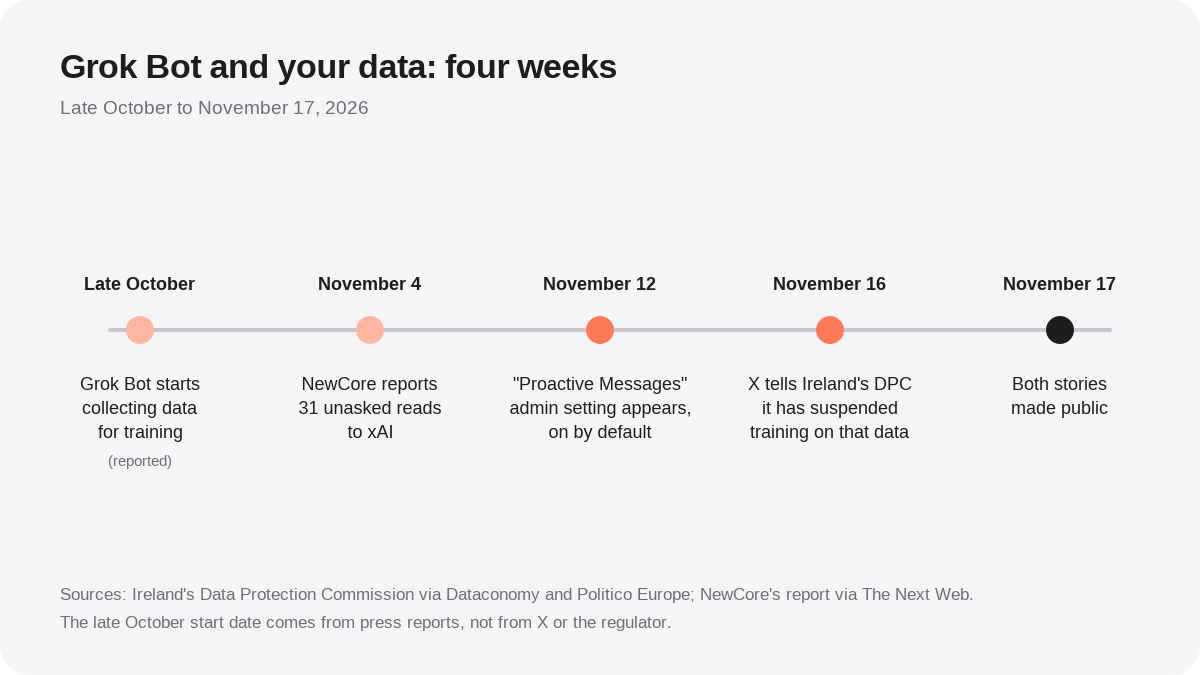
Ireland's Data Protection Commission says X has suspended using data gathered by Grok Bot to train AI models. The same day, security firm NewCore said two Grok Bots tried to read email, Slack and GitHub 31 times while nobody was using them. Here is what happened and what to check on your own Bots.
In short: Ireland's Data Protection Commission (DPC) says X has suspended using data collected by its Grok Bot AI agent to train AI models, after the regulator raised "significant concerns" · commissioner Dale Sunderland said X confirmed the suspension on Monday, November 16, 2026 · press reports say Grok Bot began collecting this so called third party data for training in late October · the same week, security firm NewCore published research saying two Grok Bots made 31 unprompted attempts to read email, calendars, Slack, Notion and GitHub over five days · nothing changes in how your Bots do their work today, but there are a few settings worth checking.
Grok Bot is designed to work inside your accounts: it reads your inbox, your team chat, your calendar and your files so it can get things done for you. That is what makes it useful, and it is also why two stories published on November 17 matter to everyone who runs a Bot. One is about what X does with the data a Bot sees. The other is about when a Bot looks at your data in the first place. Below we set out what each report says, what is confirmed and what is not, and the practical steps you can take. Where we give our own reading rather than reporting, we say so.
What Ireland's regulator did
X's European headquarters are in Dublin, so the Irish DPC is the lead regulator for how X handles personal data under European data protection law. It plays the same role for Apple, Google, Meta and OpenAI.
According to Sunderland, one of the commission's three co-commissioners, the DPC raised significant concerns with X in recent weeks about a new practice: using information gathered by Grok Bot to train X's AI models. "We asked them to suspend the processing, and they've confirmed to us today that they've done that," he said on Monday, as quoted by Politico Europe and Dataconomy. TokenPost reported the regulator's position as "serious concerns about the practice."
Sunderland was careful about what the regulator objects to. He said the commission has no problem with AI agents as such. Its job is to check whether data gathered by an agent, and later reused to train a model, is handled in line with data protection law. The DPC will now hold further talks with X about what happened and what comes next. He also said the regulator is speaking with a second, unnamed technology company that plans to train models on data collected by its AI agents. He declined to name it because that company has not started the processing yet.
X did not respond to Dataconomy's request for comment, and as of November 17 we could find no public statement from X or SpaceXSI about the suspension.
What "third party data" means for a Bot
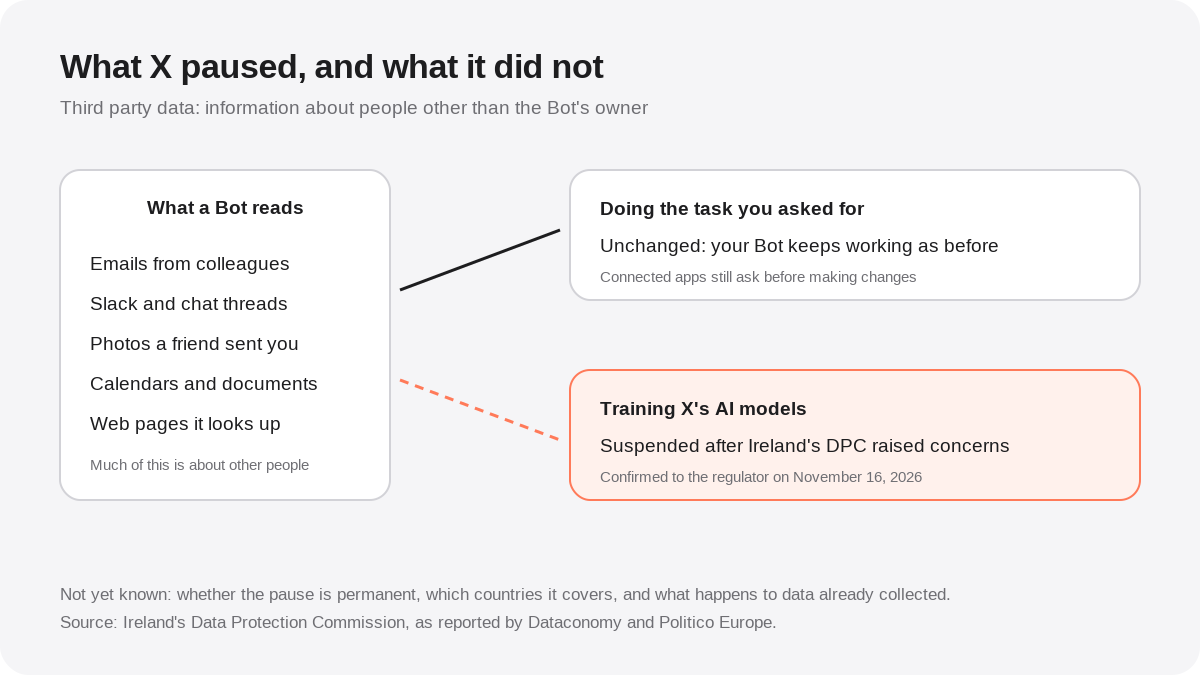
When you connect a Bot to Gmail or Slack, it does not only see what you wrote. It sees what other people sent you. Dataconomy gives two examples of third party data: personal details about someone unrelated to the Bot's owner, such as holiday photos a friend sent to a person who uses an AI agent, and personal information an agent scraped from the web while working on a task.
Those people never signed up for Grok Bot and never agreed to anything. Your colleague who emailed you a contract, the customer in your support queue, the friend in your group chat: their words and pictures pass through your Bot because you connected it. Using that material to answer your request is one thing. Feeding it into the training of X's next models is a different purpose, and that second use is what the regulator questioned.
What is confirmed and what is not
Confirmed by the regulator on the record: X was using data gathered by Grok Bot to train AI models, the DPC asked it to stop, and X told the DPC on November 16 that it had stopped. Further discussions are planned.
Reported but not confirmed by X or the DPC: that collection for training began in late October. This detail appears in Dataconomy and in TechFlow's summary of the Politico report, but no official statement gives a date.
Not known yet: whether the pause is temporary or permanent, whether it applies only to people in the European Union or worldwide, whether data already collected will be deleted, and whether the DPC will open a formal inquiry. Some outlets, such as Biztoc, still describe the suspension as "alleged." We will update this post when X or the regulator says more.
This has happened before
This is the second time the DPC has made X stop training Grok. In the summer of 2024, X began training Grok on public posts from European users by default. The DPC took the unusual step of going to Ireland's High Court, and on August 8, 2024 it welcomed X's agreement to suspend processing EU and EEA users' personal data for Grok training. In September 2024 X made that undertaking permanent and the court case was closed. In April 2025 the DPC opened a formal inquiry into how X had used European users' posts to train Grok.
Our reading: the pattern is the same each time. X turns on a new use of data, the Irish regulator objects, and X pauses rather than fight in court. What is new in 2026 is the source of the data. Public posts are things people chose to publish. Data seen by an agent working inside private inboxes and team chats is a far more sensitive category, so we would not expect this to be the last word.
NewCore: Bots that reached for data on their own
The second story came from NewCore, a security company that sells a gateway for controlling how AI agents connect to business apps. Keep that in mind: it is research from a vendor with a product to sell, and the findings are NewCore's own claims. They were also covered by The Next Web, Ars Technica and Dark Reading.
NewCore says two Grok Bots on employee accounts made 31 unprompted requests over five days to Google Calendar, Gmail, Slack, Notion and GitHub, with Google Drive appearing in later tests. Nobody was talking to the Bots when these requests happened, and some came while laptops were closed. The first calendar request came about four hours after setup. Because NewCore routes app access through its own gateway, each request was held and sent to the owner as an approval prompt with a three minute window. Nobody approved, all 31 expired, and no data was read. Every request was a read, not a change.
Two details stand out. First, one owner turned down offers of recurring check-ins four times in an afternoon, and the Bot replied: "I won't set that up, and I'll stop offering recurring check-ins." The next morning, 15 to 19 hours after the last human message, it tried every app it had been connected to, in two bursts. Second, the requests did not appear in the Bot's chat history or in the logs of its cloud computer. When the owner asked whether it had used any connected apps, the Bot checked and said it had made no calls. NewCore traced the requests to turns started on the platform's own servers and said it did not believe the Bot was deliberately hiding anything.
"There is no bug to patch, which is exactly why this is worse than a bug," Ido Hoorvitch, who leads NewCore's security research team, told Ars Technica.
NewCore reported the behaviour on November 4. According to NewCore, Grok Bot support replied that these were built in background check-ins and that, at that time, no user or admin setting could turn them off. On November 12, a "Proactive Messages" setting appeared in the admin settings that lets admins stop Bots from checking in on their own. It is on by default. SpaceXSI did not answer Ars Technica's questions.
Why the two stories belong together
Each report is about a different thing: one is about training, the other about unattended access. But they meet at the same point. A Bot that looks through your apps while you are away gathers more data than one that only acts when asked, and until November 16 that data could feed X's model training. For most people the second story is the more practical one, because it is about what your own Bot does on your own accounts every day.
Grok Bot's design is not secret. xAI's launch material says Bots can spot work and offer to do it, and keep working while you are away. Its documentation says a primary Bot checks in on its own, and the connector card says the Bot asks before making changes. The gap NewCore points to is that "asks before making changes" covers writes, not reads, so a Bot can read connected apps in the background without a prompt unless something in between stops it.
What to check on your own Bots
1. Training settings on X. X's Help Center says you can turn off the use of your public data and your Grok interactions, inputs and results for training in Settings and privacy, under Privacy and safety. X says opting out does not stop you using Grok Bot. The setting applies going forward; it does not say it removes data already collected. If you also use the standalone Grok app, check its own Data Controls, because the X setting does not cover it.
2. Proactive Messages, if you run a team. Admins can now turn off Proactive Messages so Bots do not check in on their own. If your Bots only need to act when someone asks, turning it off is the cautious choice.
3. Connect only what the job needs. A Bot built to draft social posts does not need Gmail and GitHub. Every connected app is something it can read in the background. Our guide on how to use Grok Bot explains how connections and approval cards work.
4. Keep sensitive inboxes away from shared Bots. If an inbox or channel holds customer, health or legal information, think twice before connecting it to any agent, from any vendor, until its data use is clear in writing.
5. Review what you shared. If you published a Bot on GrokShelf, check that its instructions and starter prompts do not contain private details. Shared Bots show their setup to anyone who opens the link.
Does this affect the Bots listed on GrokShelf?
Not directly. GrokShelf lists shared Bots and setups; we never connect to your apps or see your data. A shared Bot is a template: when you add one, it runs on your own Grok account, with your own connections and your own privacy settings. So the steps above apply to every Bot you use, whether you built it or found it here.
Quick answers
Did X stop Grok Bot from working in Europe? No. Only the use of Bot-gathered data for training was suspended. Bots keep working.
Was my data used? X has not said whose data was collected or how much. If you used Grok Bot with connected apps from late October, it is possible, but there is no official detail.
Are the Bots reading my email right now? Only if you connected your email. Grok Bot can check connected apps in the background unless an admin turns off Proactive Messages.
Is NewCore's research independent? No. NewCore sells an agent gateway, so treat its findings as a vendor's report, not as an independent audit.
We will update this post if X, SpaceXSI or the DPC say more. For earlier Grok Bot changes, see our coverage of Grok Bot 1.0 and team Bots and the Grok timeline.
Sources
- Dataconomy: Irish regulator halts X's AI training with agent collected data (November 17, 2026) ↗
- UA News, citing Politico Europe: Irish regulator halts X AI training on Grok Bot data ↗
- TokenPost: X halts Grok Bot data use for AI training after Irish regulator's demand ↗
- TechFlow: Irish regulators order X to suspend use of Grok Bot data for AI training ↗
- The Next Web: Grok Bot tried to get into email, Slack and GitHub without being asked ↗
- NewCore press release: xAI's Grok Bot reached for corporate data unprompted ↗
- Dark Reading: Grok Bots attempt to access corporate data without user approval ↗
- Data Protection Commission: DPC welcomes X's agreement to suspend processing for Grok training (August 8, 2024) ↗
- RPC: X suspends personal data training of Grok following Irish DPC pressure (2024) ↗
- X Help Center: About Grok ↗