SpaceXSI says five Grok Bots now handle most of its routine accounting, and Elon Musk says Grok Bot can do yours. We look at what each Bot does, how long they took to train, what still needs a person and how to try the same idea on a smaller scale.
Elon Musk doesn't post about invoices very often, so it stood out when he did on Wednesday. "Grok @Bot can do your accounting," he wrote on November 18, quoting the official Grok Bot account. That account was sharing a case study SpaceXSI had put out two days earlier, about something the company has been doing inside its own finance team for a while.
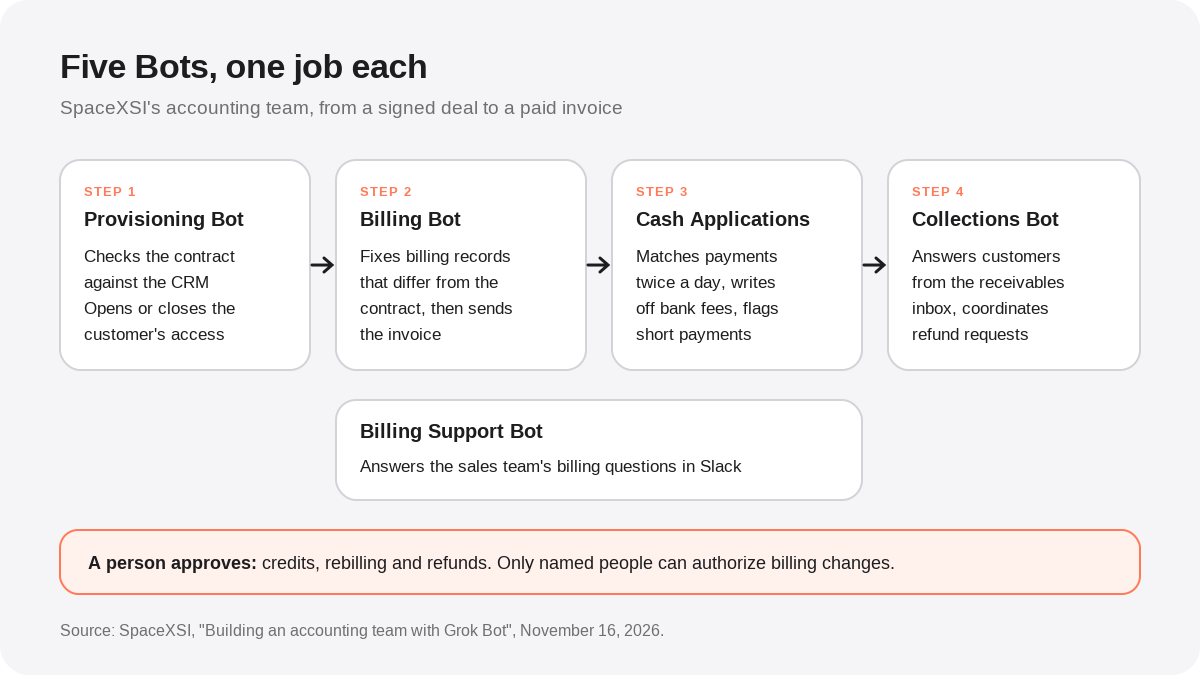
The short version: five Grok Bots now do most of the routine work between a customer signing a contract and their money landing in the bank. One sets up customer accounts. One sends invoices. One answers billing questions from the sales team, one matches incoming payments to invoices, and one deals with customers about what they owe. People still sign off on anything that sends money the other way, like refunds and credits.
You should be a little wary of any company writing about its own product, and we were too. SpaceXSI makes Grok Bot, and the page ends with a download button. But the write up is more honest about the hard parts than most of these things are. It admits the first Bots took weeks to train and one took about three months. It spends more words on permissions and approval rules than on the wins. If you're thinking about giving a Bot a real job, that's the part worth reading, so that's what we focus on here.
What SpaceXSI actually published
The post is called "Building an accounting team with Grok Bot", and it's signed by three people from the accounting team: Annay (Paul) Bains, Will Smerdon and Erin Jenks. It opens by saying five Grok Bots "each own an accounting job end to end, from provisioning a customer account to collecting payment," and that they "only involve a person when the work needs judgment."
The Grok Bot account on X put it more bluntly: "Five Bots now have full-time roles on our accounting team. We onboard, train, and manage them just like human teammates." Once Musk quoted that, the story was picked up by Benzinga, TeslaNorth and TechFlow.
All five are Team Bots, the shared kind that arrived with Grok Bot 1.0. They sit in Slack with the rest of the team instead of belonging to one person. Accountants have a name for the stretch of work they cover together: order to cash.
Meet the five Bots
Provisioning Bot is the first one a new customer deals with, though they'd never know it. When a deal closes, it reads the signed contract, checks it against the CRM and makes sure the order details line up. Then it switches the account on through an internal app, checks the access against the contract one more time and messages the sales rep in Slack to say the customer is ready. When a contract ends, it takes the access away. Someone on the team used to do all of this by hand.
Billing Bot picks up from there. Before it sends an invoice, it compares the billing system with the contract. If they don't agree, it fixes the billing record so the invoice isn't held up, and tells the team that owns the CRM so they can fix the source. One small detail we liked: if a customer hasn't given a VAT or GST number, the Bot tells the rep what tax is about to be charged and gives them 24 hours to get the number in. It can issue credits or rebill a customer, but only with extra permissions and someone's approval.
Billing Support Bot is the one the sales team talks to most. Say a customer complains that the usage on their invoice doesn't match their dashboard. The rep asks the Bot, and the Bot digs through the records and explains the gap. It can also make small changes, like updating the billing email or adding people to the invoice list. Even then, it checks that the new addresses are on the customer's own domain before it touches anything.
Cash Applications Bot does the job most accountants would happily give away: matching payments to invoices. It checks the payment feed twice a day and applies anything that matches exactly. When a payment doesn't match, it goes looking in the support system for remittance details that say which invoices the money was meant for. Small bank fees that throw the totals off get written off. If a customer has paid less than they owe, it flags the short payment for the collections team.
Collections Bot is the only one of the five that talks to customers directly, which is also why it took the longest to get right. It watches the accounts receivable inbox, answers billing questions and pulls in the other Bots when a request needs them. A refund, for example, goes through Billing Bot and Cash Applications Bot, which look into it and prepare the steps. Nothing goes out until a person approves it.
The part most people will skip, and shouldn't
The list of Bots made the headlines. How they were set up is the useful bit. SpaceXSI says it plainly: "One common misconception about AI agents is that they should be able to do a job as soon as you give them access to the right systems." The team found the opposite. Bots need what any new hire needs: documentation, onboarding and someone checking their work for a while.
They fixed the process first. "A Bot will struggle to run a process that people haven't already figured out how to perform reliably," the post says. So before handing anything over, the team built small internal apps with Grok Build that spell out how each process works and which actions are allowed. Provisioning Bot isn't making it up as it goes. It runs an app built for that one job, and every action is logged, whether a person or a Bot took it. The post says the provisioning app itself was made with Cursor, which SpaceX bought in August, according to The Next Web.
Every Bot has a manual it can't edit. Each one has a Notion document that works like a job description: how to verify a contract before invoicing, which billing changes need approval, and so on. The Bots reread their manuals every night and flag anything that conflicts with what they've been told. They can't change the manuals, though. Only the people who own each process can. To us that's the smartest decision in the whole setup, because it keeps people in charge of how the work gets done, not just whether it gets done.
Reading is easy, changing is hard. Accounting records end up in financial reports and audits, so the Bots can read what they need but can only change a narrow set of things. Low risk work runs on its own. Credits and refunds need a sign off, and only named people can give it. Anyone can ask Billing Support Bot to explain an invoice, but only a few people can approve a change to a billing record. The Bots reach internal systems through private connections such as Tailscale, so nothing internal has to be opened up to the internet, and each connection is tied to the person who approved it.
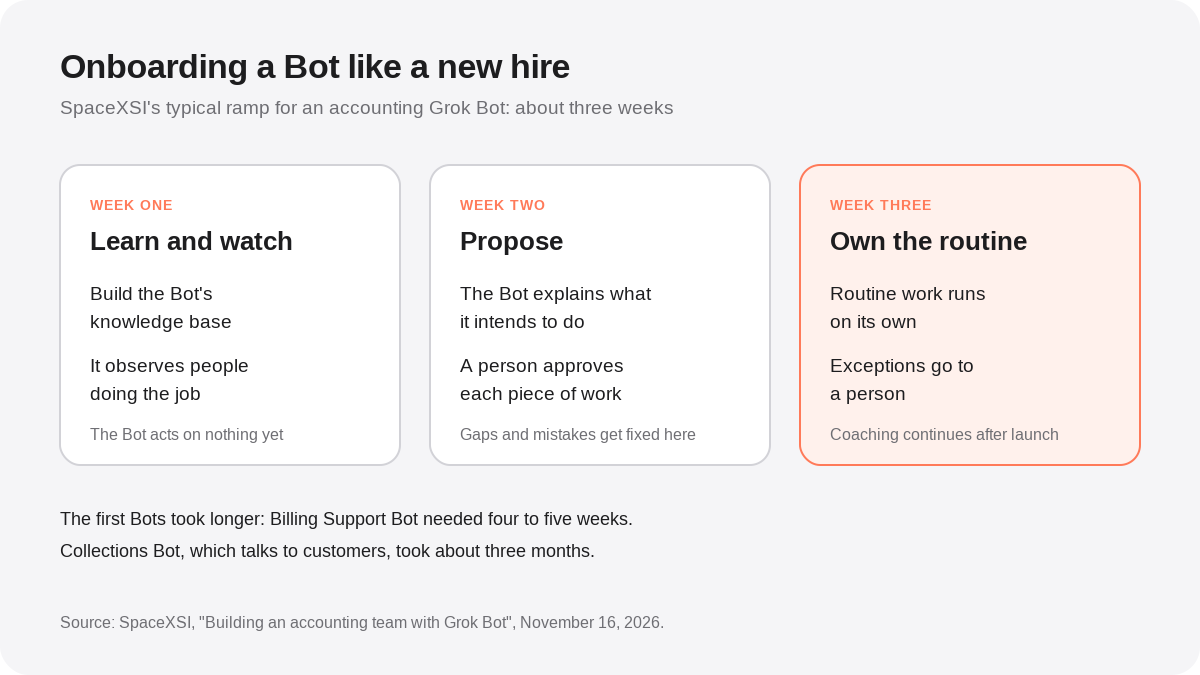
Nobody got trusted on day one. New Bots now go through a three week ramp, shown below. The first ones were slower. Billing Support Bot took four to five weeks. Collections Bot took around three months, and the reason is a good one: before it shares any account details, it has to confirm that the sender's email matches an approved contact in both the CRM and the billing system. A domain that only looks right isn't good enough. If anything is off, the message goes to a person.
Do the numbers hold up?
SpaceXSI gives three. Sending an invoice used to take about 24 hours and now takes minutes. Applying a batch of payments took an accountant three to four hours and now takes the Bot about 30 minutes. And Billing Support Bot saves the team an estimated eight hours a day. Without the Bots, the company says, the work "would require more than doubling the headcount on our team."
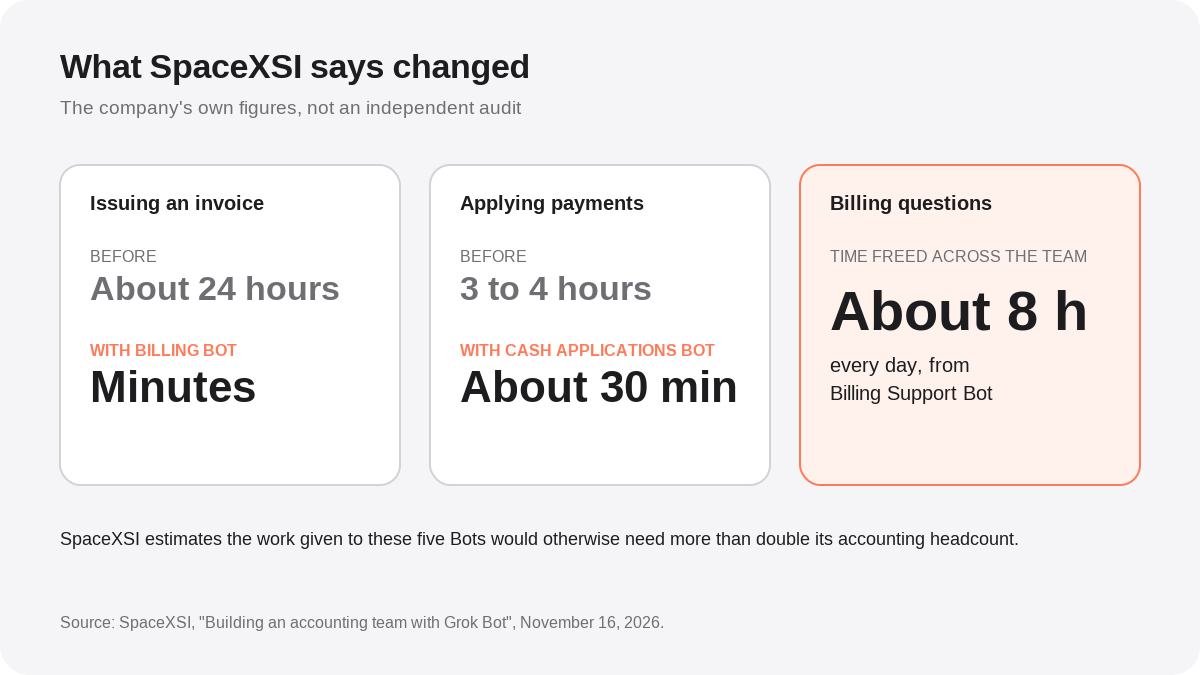
We'd take those with a pinch of salt. They're internal estimates from the company that sells the product, and nobody outside has checked them. There's also nothing about mistakes. We don't know how often a Bot misread a contract, put a payment against the wrong invoice or passed something to a person that it could have handled itself. That's the number we'd most like to see.
It's also worth remembering who did this. SpaceXSI has its own engineers, built its own apps for the job and sits down the hall from the people who make Grok Bot. A ten person business won't have any of that, so don't be surprised if it takes longer than three weeks.
Still, read closely and the claims are fairly modest. The Bots do routine, well documented work. People still control any money leaving the company. And the accountants are still there: the post says they now spend their time "managing the work, improving the systems, and resolving exceptions." Nobody is mentioned as losing their job.
What this says about where Grok Bot is going
Most of what we've written about Grok Bot so far has been about personal use: one person, one Bot, a few connected apps. This is different. These Bots hand work to each other, like Collections Bot pulling in two others for a refund. They run on a schedule, with the twice daily payment check and the nightly reread of their manuals. And they work inside a company's own private tools, not just the usual public apps. That's a lot closer to a coworker than an assistant.
It also lands in the middle of a fair argument about how much Bots should do without being asked. This week security firm NewCore reported Grok Bots reading connected apps in the background, which we covered in Grok Bot and your data. SpaceXSI's setup is a decent answer to that worry: wide read access, tight write access, named approvers and a log of everything. But it's an answer you have to build yourself. Grok Bot doesn't come set up that way out of the box.
Trying it yourself, on a smaller scale
You don't need five Bots or a finance department to use any of this. If you're a freelancer chasing late invoices or a small team closing the month, one Bot doing one job is plenty to start with.
1. Pick one job. SpaceXSI gives each Bot "a specific job that a person on our team would otherwise perform." Choose something you already do the same way every week, like chasing overdue invoices or matching payments.
2. Write the manual before you set anything up. The steps, the exceptions, who approves what. Keep it somewhere the Bot can read but can't edit. If you can't write the job down, the Bot won't do it reliably either.
3. Let it read a lot and change very little. Connect only the apps the job needs. Anything that sends money, issues a credit or emails a customer should wait for your approval. Our guide to using Grok Bots safely covers those settings, and how to use Grok Bot explains approval cards.
4. Give it three weeks. In week one it watches and asks questions. In week two you approve everything it suggests and correct what it gets wrong. In week three you let it handle the routine cases, and you keep spot checking after that.
5. Don't start from a blank page. GrokShelf lists finance Bots and Blueprints you can adapt. Invoice Hunter keeps track of overdue invoices, the Financial Close Checklist helps with month end, and the Expense Review Assistant lines up exceptions for a person to look at. Use one as a starting point, then add your own manual and approval rules.
Quick answers
Can Grok Bot really do my accounting? Going by SpaceXSI's experience, it can do well defined accounting tasks after a few weeks of setup, with a person approving the sensitive parts. It won't replace an accountant's judgment, and SpaceXSI doesn't say it will.
Which tools did SpaceXSI use? Slack, Notion, Tailscale, a CRM, a billing system, a payment feed, a support system and internal apps built with Grok Build and Cursor. It doesn't say which CRM or billing software.
Can I add these exact Bots? No. They're internal Team Bots and haven't been shared. You can copy the approach, not the Bots.
Do refunds go out automatically? No. A person has to approve every refund, and credits and rebilling need extra permissions.
Is this proof that AI agents work in finance? Not on its own. It's the company's own case study with its own numbers. Detailed and believable, but nobody has checked it independently.
If SpaceXSI shares more, such as error rates or a template for these Bots, we'll update this post. For the rest of this week's Grok news, see Grok news or the Grok timeline.
Sources
- SpaceXSI: Building an accounting team with Grok Bot (November 16, 2026) ↗
- Elon Musk on X: "Grok @Bot can do your accounting" (November 18, 2026) ↗
- Benzinga via TradingView: Elon Musk says Grok can do your accounting as SpaceXSI adds five full time AI Bots ↗
- TeslaNorth: Grok Bots are handling the books at SpaceXSI (November 18, 2026) ↗
- TechFlow: SpaceXSI uses 5 Grok Bots to handle accounting work ↗
- The Next Web: SpaceXSI's Grok Build left 35,000 apps open, security firm Claroc says (on SpaceX's purchase of Cursor) ↗